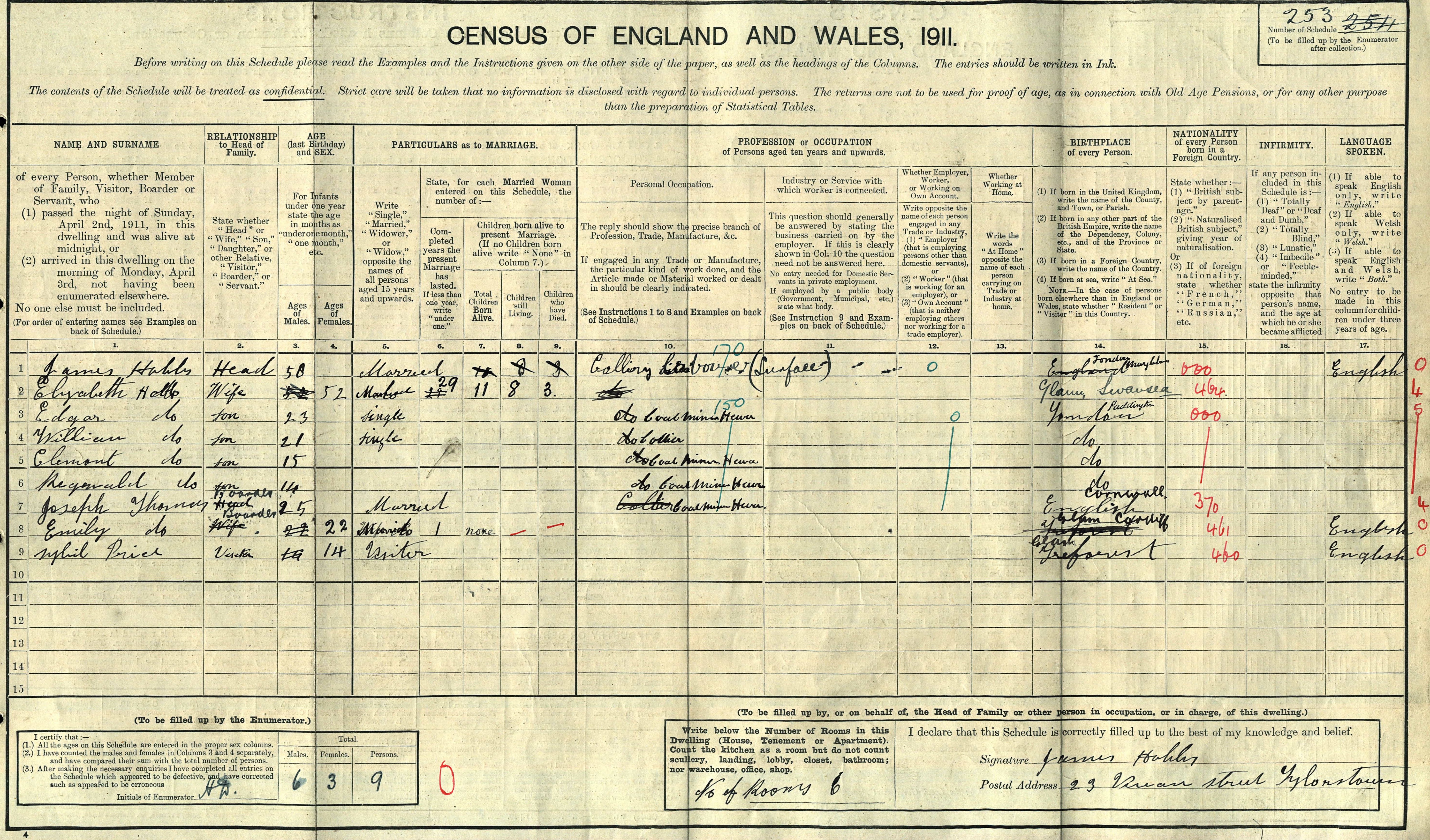
THE HOBBS FAMILY - 1901 CENSUS and 1911 CENSUS
The business of "Thomas Hobbs &Sons" was situated at 14,15 and 17 Wharves, North Wharf Road, Paddington, London. The 1901 Census shows that at
18 Northside, North Wharf Road, Paddington, London
|
Name |
Age |
Status - Occupation |
Born |
| Thomas HOBBS | 65 | Scavenging Contractor - Employer - Head | Kensington London |
| Susannah Ann SARKISS | 29 | Daughter | Paddington London |
| Abraham George SARKISS | 30 | Scavenging Contractor's Foreman - Son in Law | Assanan Eygpt (foreign Subject) |
| Lloyd Thomas William SARKISS* | 10m | Grandson | Paddington London |
(PRO ref RG13/1 Page 10 entry 283) - * transcription error - should be Louis not Lloyd
Susannah Emma (transcription error) was my great grandfather JAMES HOBBS stepsister. Next door at
18 Northside, North Wharf Road, Paddington, London
|
Name |
Age |
Status - Occupation |
Born |
| James HOBBS | 47 | Foreman of Dustyard - Worker - Head | St Pancras London |
| Elizabeth HOBBS | 42 | Wife | Breconshire South Wales |
| Lily HOBBS | 18 | Paddington London | |
| Thomas HOBBS | 16 | Shop Assistant - Worker | Paddington London |
| Willie HOBBS | 11 | Paddington London | |
| Charlie HOBBS | 8 | Paddington London | |
| Norman HOBBS | 7 | Paddington London | |
| Clement HOBBS | 6 | Paddington London | |
| Annie STEADMAN* | 40 | Dressmaker | Birmingham Warwick |
| Rosie STEADMAN* | 13 | Kilburn London |
* were visitors to the property on the night of the Census
The business of "Thomas Hobbs & Sons" was left to William and John HOBBS on the death of their father Thomas in 1907 age 72. My great grandfather James or any of his family were mentioned in the will. In fact there are indications that the family left London for South Wales a couple of years before Thomas Hobbs died. The Sarkiss family (James's stepsister) moved from Paddington to Brighton at sometime between 1904 - 1905 and I am of the opinion that is when the Hobbs Family moved to Wales. The reason for this is that of employment. I have no way of knowing for sure but I think that both Abraham Sarkiss, and my great grandfather James were told that they told that they did not feature in the will and that there was no future for them in the company. And so they left. The company was contracted to clean the streets of horse manure amongst other things, but the turn of the century saw the introduction of the motor car and it could have been this factor that coloured the decision of the family to leave.
The 1911 Census has the family living in South Wales - the transcribers of the 1911 Census named the family HABBS not HOBBS
There are a few photographs showing the Hobbs business in Paddington but the quality is not at all good. The photos themselves date from the nineteenth century but there are no additional details on either of them


Details of William and John's sister (and my great grandfather's stepsister) SUSANNAH EMMA HOBBS are on a separate page.
As a postscript, THOMAS HOBBS' death certificate reveals that his son JOHN HOBBS was the informant and was present at the time of death. Revealingly, it gives his address as 108 Delaware Mansions, Maida Vale, London.
NOTES
Delaware Mansions is named after Delaware Road which was approved in 1875. During that time the road was only paved, however between 1905 and 1907 the road was properly constructed. There was no particular reason for the name of the road, other than when Ashworth, Biddulph, Castellain and Delaware Roads were built (or extended) in 1893, the developers of the Paddington Estate, the Paddington Trustees and the Church Commissioners, wanted the initials of the street names to run alphabetically. Delaware is an American state named after the Indian tribe that used to live there.
Delaware Mansions was built in 1903- 4 and was occupied by 1905 when residents were first mentioned in the 1905 Electoral Registers.
Delaware Mansions was built on a number of allotments and was designed by the architects Boehmer and Gibbs, whom are responsible for the design of a great number of Maida Vale's mansion blocks.
In 1981 the Church Commissioners decided to sell the entire
Maida Vale Estate, offering tenants a 20 per cent discount on the assessed
market value of their flats. The tenants of the individual flats in Delaware
Mansions were granted long leases and repairs and improvements have been carried
out to Delaware Mansions over the recent years.
Delaware Mansions has recently figured in an important legal decision in the
House of Lords. The case involved Delaware Mansions Limited, the management
company owned by the tenants of the block, and its subsidiary, Flecksun Limited,
and they won their case. In 1990 Flecksun acquired the freehold of Delaware
Mansions from the original owners and developers, the Church Commissioners. The
case concerned a London plane tree growing in the pavement outside flats 73 to
92 Delaware Mansions in the 1990s, and how much Westminster City Council was
responsible for it. The tree had been planted when the block was built and
during the twentieth century had almost reached the height of the 5-storey
block.
Opposite Delaware Mansions is the distinctive building housing the BBC studios.
Originally this was the Maida Vale Skating Palace and Club, which opened in 1909
and had one of the largest and most elegant roller-skating rinks in the world.
It could accommodate hundreds of skaters and seated 2,620 people at any one
time.
The first mansion blocks were built in the early 19th
Century, providing luxurious residences for the growing urban upper middle
classes. As the Industrial Revolution spread throughout Europe it brought about
a population boom in the major cities, and mansion blocks were devised to
provide luxurious housing for wealthy white collar workers. As the centre of the
cities became increasingly crowded the blocks provided this growing class with
housing that boasted impressive entrances, generous elevations and balconies
reminiscent of mansions. They were a particularly popular innovation in polite
Parisian society.
In spite of their popularity on the continent, Londoners were initially
sceptical about this new style of accommodation.
In the 1850s a spacious mansion flat would set back the buyer somewhere in the
order of £50-200 per annum, but the idea of living in such a communal manner was
entirely contradictory to the dominant Victorian social ideals of the age.
Firstly, and most importantly, apartment dwellings were simply not considered
‘proper’, but it was not just a case of old English snobbery; there was also
widely held fear that this new type of residence would increase the risk of
burglary and the spread of infection and disease.
Sources
This page was last updated on 04/09/24 16:59